AI governance frameworks are the institutionalized toolkits organizations use to identify, assess, monitor, and address AI risk. Today they form a multi-layered ecosystem that spans value principles, international treaties, laws and regulations, standards and certification, voluntary frameworks, and technical tools. Among them, the AI Risk Management Framework (AI RMF 1.0) published by the U.S. National Institute of Standards and Technology (NIST) is the most widely cited voluntary framework in the world: it is built around four functions — GOVERN, MAP, MEASURE, and MANAGE — subdivided into 19 categories and 72 subcategories, and anchored to seven characteristics of "trustworthy AI." In July 2024, NIST added the Generative AI Profile (NIST AI 600-1), covering 12 categories of risks specific to generative AI, including confabulation, prompt injection, and intellectual property. Key peer frameworks include the certifiable ISO/IEC 42001 AI management system standard, the legally binding EU AI Act, the intergovernmental OECD AI Principles, and China's regulatory system built on algorithm filing, content labeling, and its AI Safety Governance Framework. Using the NIST AI RMF as the entry point, this report systematically maps the structure, binding force, interrelationships, and implementation paths of the world's major AI governance frameworks, and offers selection and implementation advice for enterprises. As of August 2026, global AI governance shows three clear trends: from "soft law" to "hard law," from content-generation risk to agentic AI behavioral risk, and from framework adoption to continuous runtime enforcement.
1. What Is an AI Governance Framework: Concepts and a Typology
An AI governance framework broadly refers to a set of principles, processes, controls, and accountability mechanisms that help an organization develop, procure, deploy, and operate AI systems in a trustworthy and responsible way. The core questions it must answer include: who is accountable for an AI system's consequences; how to identify and measure AI-specific risks (such as hallucination, bias, prompt injection, and data drift); under what thresholds a system is allowed to go live; and how to respond to and trace incidents after they occur. Unlike traditional IT governance aimed at deterministic software, AI systems produce probabilistic outputs, depend on data that drifts over time, and exhibit failure modes that are hard to predict and impossible to test exhaustively — which is why risk management frameworks designed specifically for AI have become necessary.
Viewed through the lenses of binding force and functional role, today's global AI governance instruments fall roughly into six layers. Understanding this layering is the foundation for everything that follows in this report:
| Layer | Binding Force | Representative Frameworks/Documents | Core Role |
|---|---|---|---|
| Value principles | None (intergovernmental consensus) | OECD AI Principles (2019/2024), UNESCO Recommendation on the Ethics of AI (2021), G7 Hiroshima Process Code of Conduct (2023) | Provide the shared vocabulary and value foundation for "trustworthy AI" |
| International treaties | Binding on state parties | Council of Europe Framework Convention on AI (CETS 225, 2024) | The first legally binding international AI treaty; establishes a human-rights baseline |
| Laws and regulations | Mandatory, with penalties | EU AI Act (2024), South Korea's AI Basic Act (effective 2026), China's Interim Measures for Generative AI Services (2023), Colorado SB 24-205, and others | Define market-access conditions, legal obligations, and penalties |
| Standards and certification | Voluntary adoption, third-party certifiable | ISO/IEC 42001 (AI management systems), ISO/IEC 23894 (AI risk management), ISO/IEC 42005 (impact assessment), China's TC260 series of national standards | Translate governance requirements into auditable, certifiable management systems |
| Voluntary frameworks | Voluntary, but often "quasi-mandatory" via procurement and litigation | NIST AI RMF 1.0 + Generative AI Profile, Singapore's Model AI Governance Framework, the UK's five "pro-innovation" principles, China's AI Safety Governance Framework 1.0/2.0 | Provide structured risk-management methodology and best practices |
| Technical tools | Voluntary | AI Verify (Singapore), OWASP LLM Top 10, MITRE ATLAS, Gartner AI TRiSM, C2PA content provenance | Turn governance principles into runnable tests, monitoring, and controls |
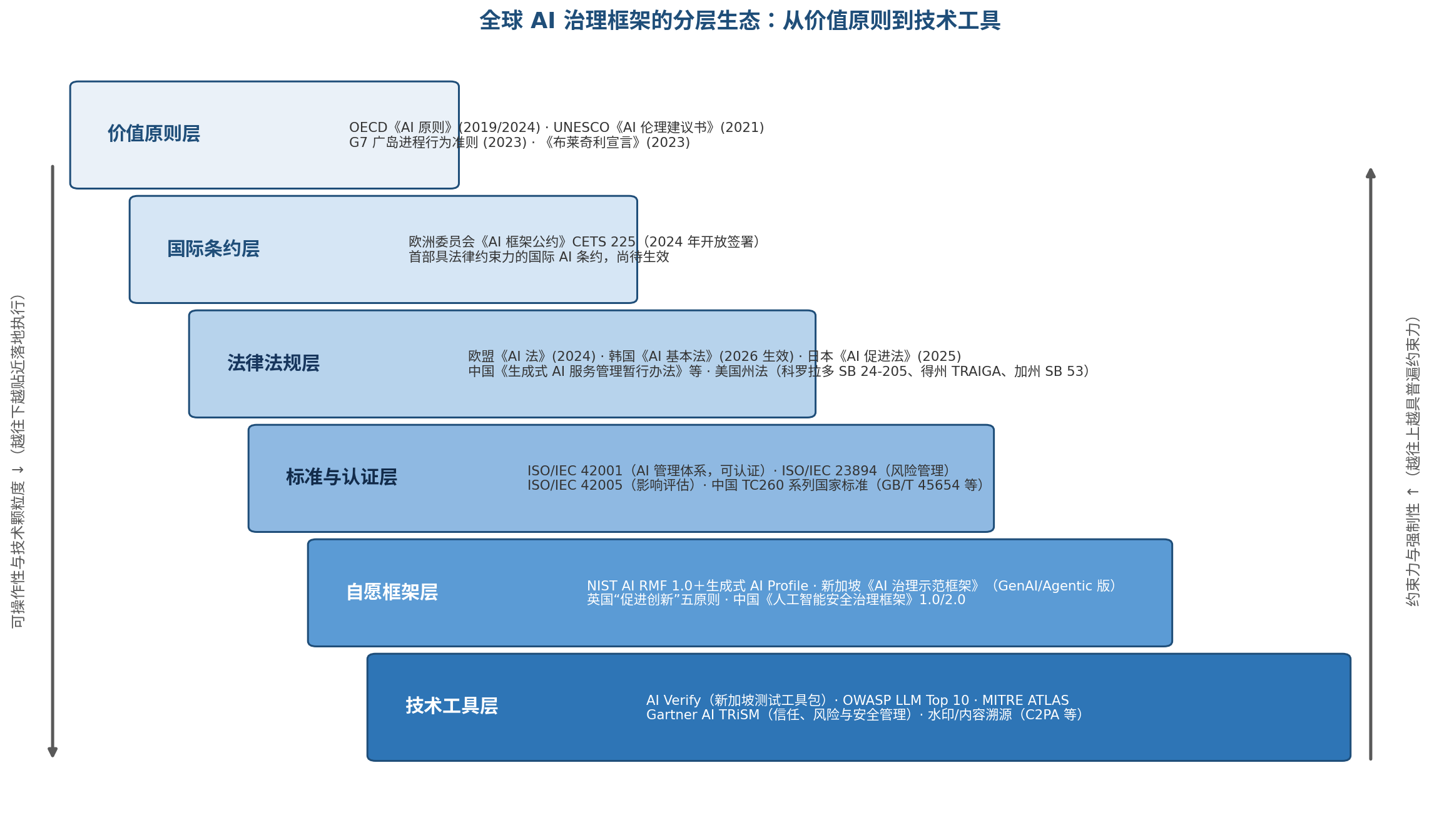
This layered picture reveals an important industry reality: no single framework covers every need. The value-principles layer (e.g., the OECD principles) enjoys the broadest consensus but is unenforceable; the laws-and-regulations layer (e.g., the EU AI Act) has binding force but governs only specific jurisdictions; the voluntary-frameworks layer (e.g., the NIST AI RMF) offers the most fine-grained risk-management methodology but relies on organizational self-discipline; and the technical-tools layer determines whether governance is "paper compliance" or "runtime enforcement." The typical approach of mature organizations is to combine them: use NIST AI RMF or ISO/IEC 42001 to build the internal governance skeleton, use regulatory crosswalks to satisfy the compliance obligations of each jurisdiction, and use technical tools for continuous monitoring and evidence retention. Each of these is expanded upon below.
One point deserves special emphasis: the relativity of the word "voluntary." Take the NIST AI RMF: it carries no legal force at the U.S. federal level, yet federal procurement rules, several state laws (Colorado's AI Act, for instance, treats it as grounds for an affirmative defense), and sectoral regulatory guidance (such as model risk management in finance) increasingly reference it, making it a de facto "quasi-compliance baseline." Similarly, although ISO/IEC 42001 is a voluntary standard, it is rapidly becoming a "governance passport" in enterprise procurement questionnaires and cross-border contracts.
2. The NIST AI RMF in Depth
2.1 Background and Legal Origins
The NIST AI Risk Management Framework (AI RMF 1.0, formally designated NIST AI 100-1) was officially released on January 26, 2023. Its legal origin is the National AI Initiative Act of 2020, in which the U.S. Congress directed NIST to lead the development of a voluntary AI risk-management framework for society as a whole. The development process followed NIST's typical consensus-driven, open and transparent model: over roughly 18 months, it received approximately 400 sets of formal comments from more than 240 organizations across industry, academia, civil society, and government — making it one of the few AI governance texts produced through broad multi-stakeholder consultation.
The framework's positioning is explicit: voluntary, non-certification-based, technology-neutral, and lifecycle-oriented. It is neither a regulation nor a standard, but an "outcome-oriented" risk-management methodology — the framework specifies only what risk-management outcomes an organization should achieve, not which technologies, metrics, or thresholds to use, so organizations can tailor it to their size, industry, and risk appetite. This design philosophy is consistent with the broader U.S. approach of "light regulation, strong standards" for AI, and it makes the AI RMF structurally reminiscent of the NIST Cybersecurity Framework (CSF) released in 2014 — the CSF's five functions (Identify, Protect, Detect, Respond, Recover) map cleanly onto the AI RMF's four functions as a clear family resemblance.
2.2 The Seven Characteristics of "Trustworthy AI"
The AI RMF's goal is not to eliminate risk, but to help organizations manage risk and maximize positive impact across the design, development, deployment, and use of AI. To that end, the framework defines seven characteristics that trustworthy AI systems should possess; these seven characteristics become the objects of measurement under the MEASURE function:
| Characteristic | Key Points |
|---|---|
| Valid and Reliable | The system performs its intended task accurately and robustly under expected conditions; robustness is grouped under this characteristic |
| Safe | Does not endanger human life, health, property, or the environment under any circumstances |
| Secure and Resilient | Can withstand adversarial attacks and recover after being attacked |
| Accountable and Transparent | System behavior is traceable to clearly identified responsible parties, with appropriate information disclosure |
| Explainable and Interpretable | Can articulate the mechanisms and rationale behind its outputs |
| Privacy-Enhanced | Protects personal data throughout collection, use, and inference |
| Fair – with Harmful Bias Managed | Identifies and controls harms caused by systemic bias |
The significance of these seven characteristics is that they break the abstract slogan of "trustworthy AI" down into engineering properties that can be individually tested and measured. The framework also candidly acknowledges inherent tensions among them — greater explainability may sacrifice accuracy, for example, and stronger privacy protection may reduce the feasibility of fairness measurement — so organizations must make trade-offs in light of concrete application contexts rather than chase full marks on every characteristic. This pragmatic attitude of "acknowledging trade-offs" is an important feature distinguishing the NIST AI RMF from many purely principle-based declarations.
2.3 Core Structure: Four Functions, 19 Categories, 72 Subcategories
The AI RMF Core is a three-tier structure: 4 Functions → 19 Categories → 72 Subcategories. The four functions are GOVERN, MAP, MEASURE, and MANAGE; the distribution of categories and subcategories under each function is as follows:
| Function | Role | Categories | Subcategories | Key Categories |
|---|---|---|---|---|
| GOVERN | Cross-cutting: cultivate a risk-management culture; establish policies, accountability structures, and processes | 6 (GOVERN 1–6) | 19 | Policies and processes, accountability structures, workforce diversity, organizational culture, stakeholder engagement, third-party risk |
| MAP | Establish context: identify system boundaries, stakeholders, and potential impacts | 5 (MAP 1–5) | 18 | Context establishment, system categorization, capabilities and cost-benefit, component and third-party risk, impacts on individuals/groups/society |
| MEASURE | Analyze and track: assess, benchmark, and monitor risk using quantitative and qualitative methods | 4 (MEASURE 1–4) | 22 | Selection of measurement methods, evaluation of trustworthy characteristics (a single category containing 13 subcategories, the largest in the framework), risk tracking, feedback collection |
| MANAGE | Respond and close the loop: allocate resources by priority, respond to incidents, communicate and recover | 4 (MANAGE 1–4) | 13 | Risk prioritization, risk treatment, third-party incident communication, incident response and recovery mechanisms |
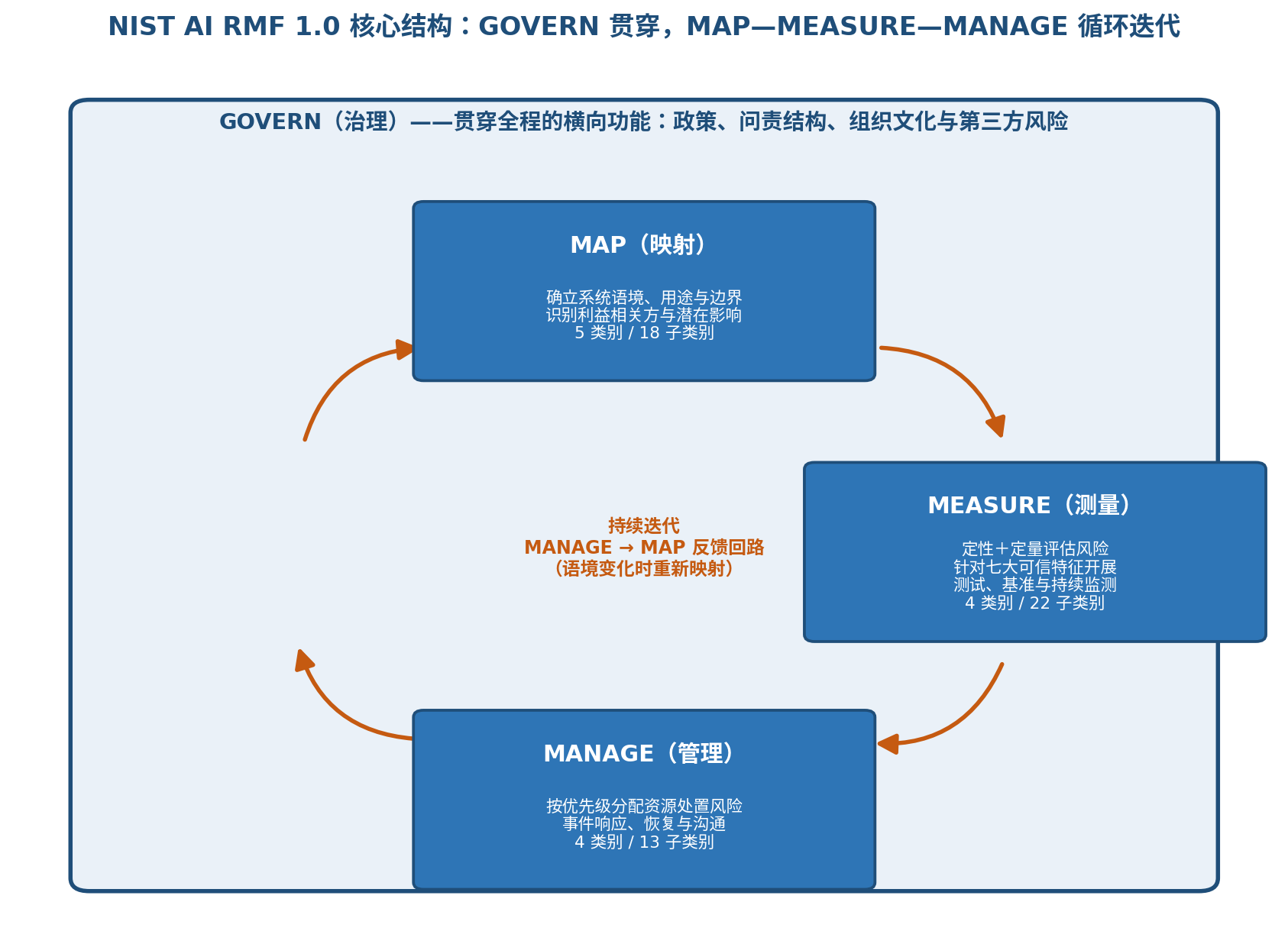
Three common misreadings of the four functions need to be corrected. First, GOVERN is not "step one" but "the air" — it is the only function NIST explicitly defines as cross-cutting; it should permeate every activity of MAP, MEASURE, and MANAGE rather than being performed once at project kickoff and shelved. Governance policies should be revisited every time a new system is mapped or a new risk is treated. Second, the four functions are not a linear process but an iterative cycle — version 1.0 deliberately added a MANAGE→MAP feedback loop: when a system's context changes (new use cases, new data sources, new regulations), the organization must return to MAP and re-map; otherwise the system moves into continuous monitoring under GOVERN. Third, the 72 subcategories are not an all-or-nothing checklist — NIST explicitly allows organizations to select relevant subcategories based on use case and risk tolerance, but requires documenting the rationale, compensating controls, and timelines for anything deferred.
Each of the four functions answers a practical question: GOVERN answers "who is responsible when something goes wrong, and who can pull the plug"; MAP answers "where in this system the risks are hiding"; MEASURE answers "how to detect the system degrading before users do"; and MANAGE answers "what to do in the moment a problem occurs." Take an enterprise deploying a customer-service LLM as an example: at the GOVERN level, it needs to designate an executive with ultimate responsibility for model outputs, set risk tolerance, and establish escalation paths; at the MAP level, it needs to lay out the model's training-data provenance, the customer populations it faces, and high-stakes scenarios where errors are dangerous (such as refund commitments or medical advice); at the MEASURE level, it needs pre-deployment testing and post-deployment continuous monitoring of hallucination rates, bias performance, and prompt-injection resistance; and at the MANAGE level, it needs rollback plans for output incidents, contingency procedures for when the vendor (the foundation-model API provider) changes behavior, and communication plans for regulators and customers.
2.4 Profiles, the Playbook, and Companion Resources
Around the core framework, NIST provides a full set of companion resources to help organizations move the framework from paper to practice. The AI RMF Playbook is an online companion document that offers actionable suggested actions, reference documents, and example outputs for each subcategory; it is not normative — organizations pick applicable actions à la carte. Profiles are the vehicle by which an organization adapts the core framework to concrete scenarios: use-case profiles target specific applications (such as hiring or credit), while organizational profiles record a given entity's risk appetite and control choices. The value of profiles lies in making trade-offs explicit — for example, demanding stricter testing for high-impact systems while applying lightweight review to low-risk internal tools.
In addition, NIST has published a Roadmap, Crosswalks to other frameworks, and sectoral perspectives. Crosswalks are especially practical: the mutual mapping completed between Singapore's IMDA and NIST is a classic example, allowing multinational enterprises to "build once, reuse everywhere" with their governance evidence and significantly reducing compliance friction. Academia and industry have also built on this foundation — researchers, for instance, have constructed maturity-model questionnaires based on the AI RMF, turning the 72 subcategories into scorable behavioral statements for organizational self-assessment; and in financial services, the Financial Services AI Risk Management Framework (FS AI RMF) translates the AI RMF into sector-specific control objectives.
2.5 The Generative AI Profile (NIST AI 600-1)
After the generative AI breakout at the end of 2022, the generality of the base framework quickly proved insufficient. In October 2023, President Biden signed Executive Order 14110, directing NIST to develop guidance specific to generative AI; in response, NIST published the AI Risk Management Framework: Generative Artificial Intelligence Profile (NIST AI 600-1) on July 26, 2024. In the form of a Profile, the document maps the four GOVERN/MAP/MEASURE/MANAGE functions onto 12 categories of risks that are unique to or significantly amplified by generative AI, and provides more than 200 suggested actions for each risk category, tagged by applicable role (developer, deployer, end user, and so on):
| # | Risk Category | Typical Content |
|---|---|---|
| 1 | CBRN information or capabilities | Lowering the barrier to accessing chemical, biological, radiological, and nuclear threat information |
| 2 | Confabulation | Producing false content with the same linguistic confidence as truthful information |
| 3 | Dangerous, violent, or hateful content | Mass generation of incitement, self-harm instructions, and hate speech |
| 4 | Data privacy | Memorization and regurgitation of training data, membership inference, de-anonymization |
| 5 | Environmental impact | Energy consumption and carbon footprint of training and inference (the document cites an estimate that training one large Transformer model emits roughly as much carbon as 300 round-trip San Francisco–New York flights) |
| 6 | Harmful bias and homogenization | Biased outputs and the long-term narrowing of diversity in the content ecosystem |
| 7 | Human-AI configuration | Overreliance, automation bias, misleading anthropomorphism |
| 8 | Information integrity | Synthetic media, deepfakes, and the spread of mis/disinformation |
| 9 | Information security | New attack surfaces such as prompt injection, model theft, and data exfiltration |
| 10 | Intellectual property | Training-data provenance, output copyright, and infringement risk |
| 11 | Obscene, degrading, or abusive content | Including non-consensual intimate imagery (NCII) and CSAM |
| 12 | Value chain and component integration | Untraceable integration of third-party models, datasets, and plugins |
AI 600-1 is markedly more operational than the base framework: rather than merely saying "manage bias risk," it prescribes concrete actions — for example, measuring confabulation as a calibration problem rather than a pure accuracy problem, conducting dedicated red-teaming for CBRN-type queries, establishing content-provenance mechanisms (digital watermarking, metadata tracking, digital fingerprinting), and instituting "stop-build authority." Its temporal arrangement is also worth noting: although the document was developed pursuant to the now-rescinded EO 14110, it remains in force as voluntary guidance and continues to be widely cited. At the same time, its limitations have emerged — the 12 risk categories are organized mainly around "what harmful content a model might generate," whereas the core risk of agentic AI, which rose to prominence after 2025, is "what harmful actions a model might take." Academia and the Cloud Security Alliance (CSA) have begun developing agent-oriented Profiles to close this gap.
2.6 The NIST AI Governance System Amid the 2025–2026 Policy Shift
The U.S. policy environment surrounding the NIST AI RMF underwent a fundamental shift in 2025. On January 20, 2025, the Trump administration rescinded Biden's EO 14110; on January 23 it signed EO 14179, Removing Barriers to American Leadership in Artificial Intelligence, directing agencies to comprehensively review and revoke existing AI policies inconsistent with the "innovation-first" course. In June 2025, the Secretary of Commerce announced that NIST's AI Safety Institute (AISI) would be renamed the Center for AI Standards and Innovation (CAISI), with the mission statement shifting from "safety" to "standards"; in May 2026, the companion AISI consortium was likewise renamed the NIST AI Consortium, with a research agenda broadened from systemic-risk mitigation to AI measurement, innovation, and the global promotion of U.S. AI technology.
For the AI RMF itself, the most consequential signal came from America's AI Action Plan, released on July 23, 2025: it explicitly directs NIST to revise the AI RMF to remove references to misinformation, diversity/equity/inclusion (DEI), and climate change. This means a framework shaped through multi-stakeholder consultation and adopted around the world will, for the first time, undergo an explicitly political revision of its content — a test of its international credibility as a "neutral technical baseline." Meanwhile, NIST/CAISI's technical output has not stalled: an initial draft of the Cyber AI Profile (IR 8596) in December 2025, the launch of the AI Agent Standards Initiative in February 2026, NIST AI 800-4 on post-deployment monitoring in March 2026, and a concept paper for a critical-infrastructure AI RMF Profile in April 2026. In June 2026, EO 14409 further established a CAISI-led "voluntary" pre-release review mechanism for frontier models. Overall, the NIST AI RMF's position as a tool remains solid, but the evolution of its content warrants continued tracking.
3. Major Frameworks Alongside the NIST AI RMF
3.1 ISO/IEC 42001: The Certifiable AI Management System Standard
If the NIST AI RMF teaches you "how to think about AI risk," ISO/IEC 42001:2023 provides the mechanism for "getting someone else to certify that you did it." Published in December 2023 and formally titled Information technology — Artificial intelligence — Management system, it is the world's first AI management system (AIMS) standard and, among the mainstream AI governance frameworks, the only one that can be third-party certified. It shares the same Harmonized Structure as ISO 27001 (information security) and ISO 9001 (quality management); its certifiable requirements are distributed across Chapters 4 through 10 and follow the PDCA (Plan–Do–Check–Act) cycle:
| Chapter | Theme | Core Requirements |
|---|---|---|
| Chapter 4 | Context of the organization | Define the AIMS scope; identify stakeholders |
| Chapter 5 | Leadership | Top management accountability for the AI policy; allocation of roles and resources |
| Chapter 6 | Planning | AI risk assessment and treatment, AI objectives, the AI system impact assessment process (6.1.4) |
| Chapter 7 | Support | Resources, competence, awareness, communication, documented information |
| Chapter 8 | Operation | Execute risk treatment, conduct periodic impact assessments (8.4), manage the AI lifecycle |
| Chapter 9 | Performance evaluation | Monitoring and measurement, internal audit, management review |
| Chapter 10 | Improvement | Correction of nonconformities and continual improvement |
The key requirement distinguishing it from information-security standards is the AI system impact assessment: organizations must assess an AI system's impacts on individuals, groups, and society (not merely on the organization itself), reassess when the system changes significantly, and retain the results — thereby institutionalizing fairness, safety, and human-rights considerations. The standard also includes approximately 38 Annex A controls spanning 9 control domains (policy, internal organization, resources, impact assessment, data, information disclosure, and others), and organizations must compile a Statement of Applicability (SoA) explaining the rationale for including or excluding each control. The certification process resembles ISO 27001: a Stage 1 documentation audit plus a Stage 2 operational audit, with certificates valid for three years subject to annual surveillance audits; the companion standard ISO/IEC 42006:2025 regulates the qualifications of certification bodies themselves.
Three common misconceptions need clearing up. First, what gets certified is the organization's management system, not any particular AI model — just as ISO 9001 does not guarantee every product is flawless. Second, it applies to users of AI, not only developers — a bank that procures a third-party credit model can equally be certified. Third, ISO 42001 certification does not equal compliance with the EU AI Act — as of 2026 it is not yet a harmonized standard cited in the EU's Official Journal and confers no "presumption of conformity"; Europe is separately developing prEN 18286 to meet the AI Act's Article 17 quality-management-system requirements. That said, a well-run AIMS does provide most of the organizational infrastructure needed for AI Act compliance. Its relationship with the NIST AI RMF is complementary rather than competitive: RMF risk-management work can serve directly as input evidence for a 42001 audit.
3.2 The EU AI Act: The World's First Comprehensive AI Legislation
The EU AI Act (Regulation (EU) 2024/1689) entered into force on August 1, 2024. It is the world's first horizontal, comprehensive AI law, adopting a risk-based, tiered regulatory model that divides AI systems into four categories:
| Risk Level | Typical Scenarios | Legal Consequences |
|---|---|---|
| Unacceptable risk | Social scoring, manipulation of vulnerable groups, biometric categorization based on sensitive traits, certain real-time remote biometric identification | Prohibited (enforced from February 2, 2025) |
| High risk | Healthcare, recruitment screening, credit scoring, education, critical infrastructure, law enforcement, biometrics | Conformity assessment, technical documentation, data governance, human oversight, accuracy/robustness/cybersecurity, logging, post-market monitoring, CE marking |
| Limited risk | Chatbots, recommender systems, generative tools | Transparency obligations (disclose AI interaction, label AI-generated content) |
| Minimal risk | Spam filtering, game AI, and the vast majority of applications | Essentially no obligations; voluntary codes of conduct encouraged |
Implementation proceeds in phases: prohibitions and AI-literacy obligations took effect on February 2, 2025; obligations for general-purpose AI (GPAI) models and the governance architecture (including the EU AI Office) began applying on August 2, 2025; the Annex III high-risk obligations, originally set to apply fully on August 2, 2026, were postponed to December 2, 2027 by the 2026 "Digital Omnibus" package, with Annex I embedded-product obligations deferred to August 2028 — while the transparency obligations (Article 50) still apply on the original schedule of August 2, 2026. Penalties follow a three-tier structure: up to €35 million or 7% of global annual turnover for violating the prohibitions (higher than the GDPR's 4%), up to €15 million or 3% for violating high-risk and other obligations, and up to €7.5 million or 1% for providing misleading information.
The GPAI rules are the EU model's most extraterritorial innovation: models trained with at least 10²⁵ FLOPs of compute are presumed to pose "systemic risk" and bear additional obligations such as model evaluation, adversarial testing, and incident reporting; only roughly 5–15 companies worldwide currently cross that threshold. In July 2025 the European Commission published the GPAI Code of Practice; 26 organizations (including OpenAI, Google, Microsoft, Anthropic, and Mistral) signed it to obtain a "presumption of conformity," while Meta publicly refused to sign. The implementation picture, however, is not encouraging: as of April 2026, 78% of organizations had taken no substantive compliance preparation, and more than half lacked even a basic AI inventory; at least 12 member states missed the statutory deadline for designating competent authorities. The essential difference from the NIST AI RMF is this: the AI RMF is a voluntary process methodology, while the EU AI Act is a mandatory market-access regulation — the former tells you how to manage risk; the latter dictates that if you fail to meet the conditions, you cannot sell in Europe.
3.3 The OECD AI Principles and the UNESCO Recommendation on the Ethics of AI
The OECD AI Principles are the first intergovernmental standard on AI: adopted in May 2019, revised in May 2024 to address general-purpose and generative AI, and currently adhered to by 47 countries and jurisdictions. They comprise five values-based principles — inclusive growth and sustainable development; human rights and democratic values (including fairness and privacy); transparency and explainability; robustness, security, and safety; and accountability — plus five recommendations for policymakers (invest in R&D, foster the ecosystem, shape an interoperable governance environment, build human capacity and prepare for labor-market transformation, and pursue international cooperation). The 2024 revision in particular expanded the language on AI-amplified mis/disinformation, privacy, intellectual property, and safety. The principles carry no binding force, but they form the normative bedrock of most subsequent legislation — the EU AI Act's risk orientation and human-rights framing were deeply influenced by them.
The UNESCO Recommendation on the Ethics of Artificial Intelligence was adopted by consensus of 193 member states in November 2021, making it the first global normative framework on AI ethics. It establishes four values (human rights and dignity; peaceful, just societies; diversity and inclusiveness; environmental flourishing) and ten principles (including proportionality, safety, fairness, transparency, and human oversight), accompanied by concrete recommendations across 11 policy action areas covering gender, data, international cooperation, and more. Compared with the OECD principles, the UNESCO text places greater emphasis on cultural diversity, environmental sustainability, and the needs of developing countries, reflecting the outcome of a genuinely global consultation. Together, these two documents form the "value-principles layer" of AI governance: they do not directly bind companies, but they supply the common vocabulary for national legislation and serve as the default reference for multinationals building internal policy in jurisdictions without hard law.
3.4 The Council of Europe Framework Convention on AI (CETS 225)
The Council of Europe Framework Convention on Artificial Intelligence and Human Rights, Democracy and the Rule of Law (CETS No. 225) was adopted on May 17, 2024 and opened for signature in Vilnius on September 5, 2024 — the first legally binding international treaty on AI. The initial signatories included the EU, the UK, the United States, Israel, and numerous Council of Europe member states; Canada and Japan joined in February 2025. The Convention takes a principles-based approach: it requires parties to ensure that activities across the AI lifecycle are consistent with human rights, democracy, and the rule of law, encompassing clusters of obligations on transparency and oversight, risk and impact management, prohibition of uses incompatible with human rights, and independent oversight bodies.
Two points are essential to understanding the Convention. First, its "binding force" binds states, not companies: the treaty creates no obligations under which companies can be directly sued or fined; parties must implement it through domestic law, and it is not self-executing. As a result, the same convention takes wildly different forms on the ground in the EU (implemented via the AI Act), the UK (light-touch co-regulation), and the United States (not ratified by the Senate, so its obligations are effectively unenforceable). Second, as of August 2026 the Convention has not yet entered into force: entry into force requires five ratifications (including at least three Council of Europe member states), yet as of early June 2026 only the EU had deposited its instrument of ratification (on May 15, 2026), and the EU, as an international organization, does not count toward the member-state threshold. Its historical significance lies in establishing an international human-rights baseline for AI governance, but in the near term, real-world constraints still come from each jurisdiction's domestic law.
3.5 The G7 Hiroshima Process and Other Multilateral Mechanisms
The G7 "Hiroshima AI Process" produced the International Code of Conduct for Organizations Developing Advanced AI Systems and accompanying Guiding Principles in October 2023, and in early 2025 further launched a "Reporting Framework" to monitor companies' voluntary adherence to the Code of Conduct and improve transparency. At the United Nations, the General Assembly adopted its first AI resolution (A/RES/78/265) in March 2024, followed by the Global Digital Compact in September 2024. The summit sequence also continues to evolve: the Bletchley Summit of November 2023 (29 countries signed the first global AI safety declaration, with China and the U.S. at the same table for the first time), the Seoul Summit of May 2024 (16 companies signed the Frontier AI Safety Commitments), the Paris AI Action Summit of February 2025 (the U.S. and UK refused to sign the declaration, revealing geopolitical rifts for the first time), and the New Delhi Summit of February 2026 (92 countries signed, but only at the price of explicitly rejecting the concept of "global governance" in exchange for the broadest possible consensus). The common feature of all these mechanisms is their "soft law" character: they sustain a shared vocabulary and promote information sharing, but none can change a company's statutory obligations in any particular jurisdiction.
4. National and Regional Governance Approaches
4.1 United States: A "Patchwork of State Laws + Voluntary Frameworks" Amid a Federal Vacuum
After the rescission of EO 14110, the U.S. federal level no longer has a comprehensive, horizontal AI regulatory counterpart; the governance center of gravity has shifted to "innovation first + procurement leverage + a patchwork of state laws." The NIST AI RMF and its companion documents form the technical baseline; OMB memoranda bind federal agencies' own AI procurement and use; and the FTC has continued its conduct-enforcement path centered on Section 5 of the FTC Act — rescinding the Rytr consent order in December 2025 and issuing a policy statement on AI and Section 5 in March 2026 — indicating that federal enforcement is consolidating around "conduct liability" rather than "product-safety obligations." Meanwhile, an executive order of December 2025 established a DOJ AI Litigation Task Force to pursue a federal preemption strategy against state AI legislation, adding uncertainty to compliance.
At the state level, three representative models have emerged. Colorado's SB 24-205 (the Colorado AI Act) is the only comprehensive, risk-based state law in the United States, and its most ingenious design is the affirmative-defense mechanism: a deployer that has implemented and maintained policies and procedures conforming to a national or international risk-management framework such as the NIST AI RMF or ISO/IEC 42001 can assert a defense in an enforcement action by the Attorney General; discovering and correcting violations through feedback, red-teaming, or internal review likewise qualifies for a defense. This turns the NIST AI RMF from a "voluntary guideline" into a litigation "talisman." The law is enforced exclusively by the state Attorney General, with no private right of action. Texas's TRAIGA adopts an intent-based list of prohibitions; California has layered multiple subject-specific statutes into a web — SB 53 (frontier-model transparency and safety), AB 2013 (training-data transparency), SB 942 (AI transparency), and SB 243 (companion chatbots). For enterprises, the difficulty of U.S. compliance lies precisely in this fragmentation amid federal absence — a governance system built on the NIST AI RMF skeleton is currently the option with the greatest cross-state reusability.
4.2 China: "Agile Governance" Starting from Application Services
China has not legislated directly against "models"; instead, it starts from application services and progressively extends regulation to the model layer through algorithm governance, forming a clearly layered, rapidly iterating regulatory system:
| Date | Document | Core Mechanism |
|---|---|---|
| 2021 | Provisions on the Management of Algorithmic Recommendation in Internet Information Services | Algorithm filing, algorithm-mechanism review, security assessment |
| 2022 | Provisions on the Management of Deep Synthesis in Internet Information Services | Labeling and filing of deep synthesis (including deepfakes) |
| 2023.8 | Interim Measures for the Management of Generative AI Services | Training-data governance, content safety; services with public-opinion attributes or social-mobilization capacity must undergo security assessment and complete algorithm filing |
| 2023.10 | Global AI Governance Initiative | Articulates an external governance vision of "people-centered, AI for good" |
| 2024.9 | AI Safety Governance Framework 1.0 (TC260) | Risk classification and comprehensive governance-measure framework |
| 2025.9.1 | Measures for Labeling AI-Generated Synthetic Content take effect | Explicit/implicit labeling of AI-generated content, establishing end-to-end traceability across "generation–dissemination–use" |
| 2025.9.15 | AI Safety Governance Framework 2.0 | Three risk categories (inherent technical, application security, application-derived) + five-level risk grading + dynamic governance measures |
At the execution level, the algorithm-filing regime is the most distinctly Chinese instrument: as of June 2025, 433 large models had completed filing and gone live. Standardization proceeds in parallel: the National Technical Committee for Cybersecurity Standardization (TC260) has published national standards including GB/T 45652-2025 (security specifications for generative-AI pre-training and fine-tuning data), GB/T 45654-2025 (basic security requirements for generative AI services), and GB/T 45674-2025 (security specifications for data annotation), and is developing sector-specific safety guidelines for finance, healthcare, education, government services, and other industries. Unlike the EU's horizontal, risk-tiered legislation, the Chinese model is summarized as "inclusive and prudent, agile governance": the AI Safety Governance Framework 2.0 articulates five principles (inclusive prudence to ensure safety; agile risk identification; combining technical and managerial measures for coordinated response; open cooperation for shared governance; trustworthy application to prevent loss of control) and, for the first time, brings catastrophic risk into the consideration of application-derived risks. For companies operating in China, filing, labeling, and content safety are three unavoidable compliance mainlines.
4.3 United Kingdom: The "Pro-Innovation" Route — No Legislation, Rely on Regulators
The UK deliberately chose the opposite path from the EU. In March 2023, the Department for Science, Innovation and Technology (DSIT) published the white paper A Pro-Innovation Approach to AI Regulation, establishing five cross-sectoral principles — safety, security and robustness; appropriate transparency and explainability; fairness; accountability and governance; and contestability and redress — but creating no unified AI regulator and no horizontal legislation. Instead, existing sectoral regulators such as the FCA, ICO, CMA, Ofcom, and MHRA interpret and apply these principles within their own statutory remits. The government's February 2024 response confirmed that no cross-sector AI bill would be forthcoming in the near term; as of mid-2026, the King's Speech for the 2026 parliamentary session still contains no AI bill.
Institutionally, the UK established the world's first AI Safety Institute (AISI) in November 2023, renamed the AI Security Institute in February 2025; it focuses on catastrophic risks and national-security risk assessment of frontier models but exercises no market-regulation powers. The advantage of this "light legislation, strong capability" route is flexibility and friendliness to innovation; the cost is weak regulatory certainty — companies face the separate guidance of several sectoral regulators rather than a single unified code. In practice, multinationals operating in the UK typically still use NIST AI RMF / ISO 42001 as their internal skeleton, then engage each sectoral regulator's expectations department by department.
4.4 South Korea and Japan: Two Legislative Paradigms in Asia-Pacific
South Korea's AI Basic Act (formally the Basic Act on the Development of AI and the Creation of a Foundation of Trust) was passed in December 2024, signed on January 21, 2025, and took effect on January 22, 2026 — becoming the world's second comprehensive AI statute after the EU's, and one with extraterritorial effect: any AI system that materially affects the Korean market falls within its jurisdiction, and foreign operators must designate a domestic representative in Korea. The statute centers its regulation on "high-impact AI" (in fields such as healthcare, finance, employment, and public infrastructure), requiring risk-management systems, human-oversight mechanisms, and fundamental-rights impact assessments; it also imposes user-notification duties for the use of high-impact or generative AI and requires clear labeling of AI-generated content. Penalties include fines of up to 30 million won and criminal liability in serious cases. Supporting legislation has seen delays — the draft enforcement decree was not published until September 8, 2025 (originally due in June) and contains 34 provisions; the National AI Strategy Committee, established in September 2025, finalized an AI action plan containing 99 action tasks in February 2026.
Japan's AI Promotion Act (formally the Act on the Promotion of Research, Development and Utilization of AI-Related Technologies) was passed on May 28, 2025, with most provisions effective June 4, 2025 and the chapters on the AI Strategic Headquarters and the AI Basic Plan effective September 1. It represents the "promotion-oriented legislation" paradigm: no fines, no direct penalties — instead, it establishes national goals, creates an AI Strategic Headquarters led by the Prime Minister, and formulates an AI Basic Plan, relying on guidance, recommendations, information disclosure, and "public naming" to drive corporate self-discipline. Substantive constraints rely on existing sectoral laws (the APPI personal-information protection law, competition law, intellectual-property law, product-safety law) together with the AI Governance Guidelines (v1.1, March 2025) jointly issued by METI and MIC, which ask enterprises to conduct risk assessments, document safety/fairness/bias testing, ensure transparency and explainability, and establish monitoring and incident-handling mechanisms — operating on a "comply or explain" basis. Korea and Japan happen to form the two poles of Asia-Pacific legislation: one moving toward EU-style comprehensive legislation, the other holding to an innovation-first soft-law path.
4.5 Singapore: Taking Voluntary Frameworks to the Global Frontier
Singapore has no unified AI law and does not intend to enact one, yet its Model AI Governance Framework has become the benchmark for voluntary frameworks worldwide, maintaining a rare pace of iteration: the first edition in 2019 (second edition in 2020) addressed traditional AI; a generative AI edition released in May 2024 is organized around nine dimensions — accountability, data, trusted development and deployment, incident reporting, testing and assurance, security, content provenance, safety and alignment research, and AI for the public good — and emphasizes "shared responsibility" among model creators, application developers, and deployers; and on January 22, 2026, at the World Economic Forum, Singapore published the world's first governance framework for agentic AI (the Model AI Governance Framework for Agentic AI), addressing the governance challenges of autonomously planning and acting AI along four dimensions: risk bounding and constraints, meaningful human accountability, technical controls, and end-user responsibility.
Another hallmark of the Singapore model is the "framework + tools" combination: AI Verify is an open-source AI governance testing framework and toolkit, operated by the AI Verify Foundation under IMDA, against which organizations can run technical tests and process checks aligned with international governance principles and generate reports. Although the framework itself is voluntary, the Monetary Authority of Singapore's (MAS) Technology Risk Management Guidelines are binding on licensed financial institutions and incorporate the framework's principles into AI/ML risk-control requirements — a voluntary framework rendered de facto mandatory through a "regulatory bridge." In addition, IMDA and NIST have completed a mutual mapping of their governance frameworks, giving multinationals a channel for reusing governance evidence across jurisdictions. Singapore demonstrates that a voluntary framework can also achieve global influence — provided it is concrete enough, actionable enough, and continuously tracks the technology frontier.
5. Side-by-Side Comparison of the Major Frameworks
Bringing the foregoing together, the table below presents a consolidated comparison of the seven mainstream frameworks (key attributes of each entity are aggregated for selection reference):
| Dimension | NIST AI RMF 1.0 + AI 600-1 | ISO/IEC 42001:2023 | EU AI Act | OECD AI Principles | Korea AI Basic Act | Singapore MGF Series | China Regulatory System |
|---|---|---|---|---|---|---|---|
| Issuer / date | U.S. NIST, 2023.1 / 2024.7 | ISO/IEC, 2023.12 | EU, in force 2024.8 | OECD, 2019 / revised 2024 | Korean National Assembly, in force 2026.1 | IMDA, three generations 2019–2026 | CAC et al. + TC260, continuously iterating since 2021 |
| Nature | Voluntary framework | Certifiable management-system standard | Mandatory regulation | Intergovernmental principles | Mandatory statute | Voluntary framework (made mandatory in finance via MAS) | Mandatory regulations + voluntary framework + national standards |
| Core structure | 4 functions / 19 categories / 72 subcategories + 12 GenAI risk categories | Chapters 4–10 PDCA + 38 Annex A controls | Four-tier risk grading + dedicated GPAI chapter | 5 principles + 5 recommendations | High-impact AI obligation clusters + transparency labeling | 9 governance dimensions (GenAI edition) | Filing + labeling + security assessment + three-category five-level risk grading |
| Certifiable? | No (self-assessment) | Yes (third-party certification, 3-year cycle) | Conformity assessment + CE marking | No | No (statutory inspection) | No (AI Verify provides test reports) | Filing regime |
| Penalties | None | None | Up to 7% of global turnover | None | Up to KRW 30 million + criminal liability | None (except in finance) | Penalties per superior law |
| Extraterritorial effect | N/A | Globally applicable | Yes (the "Brussels effect") | 47 adherents | Yes | Strong regional influence | Primarily domestic services |
| Best-fit role | Internal risk-governance skeleton | External proof of governance capability | European market-access threshold | Policy dialogue and internal values | Korean market compliance | Southeast Asia business and frontier-tech governance | Compliance for services in China |
Three structural conclusions can be drawn from this table. First, methodology, certification, and regulation each do their own job: the NIST AI RMF offers the most detailed process methodology but cannot attest to itself; ISO 42001 provides third-party endorsement but does not substitute for law; regulations such as the EU AI Act draw the market threshold but do not teach you how to comply — the optimal solution for a multinational is to build one governance system on RMF/42001 and then use mapping tables to satisfy each jurisdiction's regulations. Second, mandatory frameworks are spreading along an "EU → Korea → (potentially) other jurisdictions" path, while voluntary frameworks are deepening along a "NIST → Singapore → UK" path, and the two paths are highly convergent on core elements such as risk-based approaches, human oversight, and transparency labeling. Third, extraterritorial effect is becoming the norm: both the EU AI Act and Korea's AI Basic Act are designed with extraterritorial jurisdiction, meaning that even companies headquartered elsewhere must comply once their services touch those markets.
6. Enterprise Implementation: Adoption Status, Implementation Paths, and Common Failure Modes
6.1 Adoption Status: A Huge "Governance Gap"
Multiple industry surveys from 2025–2026 sketch the same picture: the speed of AI adoption has far outrun governance capability. A November 2025 McKinsey survey found that 88% of organizations already use AI in at least one business function, yet nearly two-thirds remain in the experimentation or pilot stage; meanwhile, Economist Impact research found that only 8% of organizations worldwide have a comprehensive AI governance framework — a figure that drops to 2% among small businesses. A September 2025 report from the World Economic Forum and Accenture is even starker: fewer than 1% of organizations have fully operationalized responsible AI, and 81% remain at the earliest stage of maturity.
The gap shows up at every link in the governance chain: 75% of organizations have an AI-use policy, but only 59% have a dedicated governance role, 54% have an AI incident-response playbook, and 48% continuously monitor production AI systems (as low as 9% among small businesses); only 30% of organizations have actually deployed generative AI systems into production. Agent governance is the biggest gap of all: Deloitte found that 74% of organizations plan to adopt agentic AI within two years, yet only 21% have a mature agent-governance model; another 35% admit that if an AI agent ran out of control, they could not shut it down. The risk consequences are already visible in the data: Stanford HAI's 2026 AI Index recorded 362 AI-related incidents in 2025, up 55% from 233 in 2024; and IBM data shows that 13% of organizations have suffered a breach involving an AI model or application, of which 97% lacked proper AI access controls.
The good news is that the returns on governance investment are equally measurable: a Gartner survey of 360 organizations found that those that had deployed AI governance platforms were 3.4 times more likely to achieve high governance effectiveness than those that had not; a joint CSA–Google Cloud survey found that organizations with comprehensive governance policies were early adopters of agentic AI at rates (46%) approaching two to four times those of organizations with weaker policies (25%/12%), and 65% had trained employees on AI (versus 27%/14%); and research by Writer found that organizations with a formal AI strategy achieved an 80% adoption success rate, versus just 37% for those without. Governance is not a brake on innovation but a prerequisite for scaling — a judgment now supported by remarkably consistent data.
6.2 Framework Selection Advice
The sensible framework combination differs by organization type:
| Organization Type | Recommended Combination | Rationale |
|---|---|---|
| Large and mid-sized multinationals | NIST AI RMF (skeleton) + ISO/IEC 42001 (external certification) + jurisdictional regulatory mappings (EU AI Act, Korea AI Basic Act, China filing/labeling) | Build once, reuse everywhere; the 42001 certificate answers procurement questionnaires; RMF evidence supports affirmative defenses under U.S. state law |
| Enterprises targeting the U.S. market | Prioritize the NIST AI RMF, layered with state-law checks for Colorado, Texas, California, etc. | The RMF is the common baseline for state affirmative defenses and federal procurement |
| Enterprises targeting the EU market | EU AI Act compliance as the mainline, with ISO 42001 providing management-system infrastructure | The AI Act is a mandatory threshold; note that 42001 confers no presumption of conformity |
| Enterprises providing services in China | Algorithm filing + labeling of AI-generated synthetic content + alignment with the AI Safety Governance Framework 2.0 | Filing and labeling are statutory actions; Framework 2.0 provides the risk-classification methodology |
| Financial institutions | Sector frameworks first (e.g., the U.S. FS AI RMF, MAS TRM guidelines), with the RMF as the general skeleton | Sector regulators have already translated general frameworks into industry control objectives |
| Startups / SMBs | Start light: an AI inventory + MAP/MEASURE for high-risk use cases; no need to chase all 72 subcategories | The framework explicitly allows risk-based tailoring; solve visibility first, then systematize |
Whichever combination you choose, two lessons are universal. First, start with an inventory — without complete visibility into the AI tools in your enterprise, vendor AI features, internal models, and employees' spontaneous usage (shadow AI), any governance is a castle in the air; EU compliance consultancies observe that more than half of organizations have not even established a basic AI inventory. Second, avoid "one framework, one system" multiplication — the overlap among mainstream frameworks is high (risk orientation, human oversight, transparency, continuous monitoring). The right approach is to build one unified governance system, then use crosswalks to map the same body of evidence onto different frameworks' requirements, rather than building a separate process for each framework.
6.3 Implementation Path: An Actionable Sequence
Combining NIST's companion resources with industry practice, a pragmatic rollout sequence looks roughly like this. Phase 1 (about one month): establish visibility — inventory all AI use cases (in-house models, vendor AI features, pilot projects, employees' personal tools), recording for each use case its business purpose, data, owner, vendors, and customer impact. Phase 2: build the governance skeleton (GOVERN) — designate the executive and committee ultimately accountable for AI risk, put risk appetite and approval paths in writing, make explicit "who can call a halt to a launch," and bring third-party models into vendor risk management. Phase 3: run MAP + MEASURE on high-priority systems — don't try to cover every system at once; pick 2–3 high-impact use cases, complete context mapping, risk identification, and pre-deployment testing (hallucination rate, bias, prompt-injection resistance, and so on), and establish post-deployment continuous-monitoring metrics. Phase 4: close the loop with MANAGE — turn untreated risks into remediation items with owners, deadlines, and evidence requirements; prepare incident-response and rollback plans; and feed lessons learned back into GOVERN policy revisions.
For generative AI scenarios, layer on the AI 600-1 12-risk checklist: due-diligence records for foundation-model and dataset vendors, content-provenance mechanisms (watermarking/metadata), acceptable hallucination-rate thresholds and go/no-go launch gates, dedicated red-teaming against CBRN and jailbreaks, and incident-disclosure protocols. Once the whole system is up and running, the mark of an organization's maturity is not "the paperwork is complete" but that the four functions form a genuine cycle: drift detected by monitoring triggers re-mapping, incident retrospectives update governance policy, and new regulations can be quickly traced to the use cases they affect.
6.4 Common Failure Modes
Industry retrospectives on AI RMF projects reveal several recurring failure modes. The most typical is "paper without practice": a company adopts the framework, writes governance policies (GOVERN), produces an AI inventory and a few system-context documents (MAP), then quietly skips MEASURE — because it lacks the data infrastructure needed to continuously benchmark risk — while MANAGE degenerates into "deal with it when something happens." The result: the framework hangs on the intranet while operational reality is unchanged. PwC's 2025 Responsible AI survey confirms this from the other side: 50% of executives identify "translating responsible AI principles into operational processes" as the biggest obstacle, ahead of cultural resistance, budget, tooling, and every other option.
The second failure mode is treating governance as a one-time project: an AI system's risk profile changes continuously with its data, users, and use cases. Turning MAP–MEASURE–MANAGE into a one-time pre-launch checklist inevitably creates monitoring blind spots — the fact that nearly half of organizations do not monitor production AI systems shows this is no isolated case. The third failure mode is governance divorced from the business: 44% of surveyed AI leaders consider governance processes "too slow" and 24% consider them "overwhelming"; when governance becomes a pure compliance bottleneck, business teams route around it, breeding shadow AI — and organizations with high shadow-AI usage bear an average of $670,000 more in breach costs. The way out is to embed governance into engineering workflows (launch gates, automated testing, runtime guardrails), so that "compliance evidence" becomes a byproduct of system operation rather than an extra documentary burden.
7. Frontier Trends: From Generative AI Governance to Agent Governance
In 2025–2026, the leading edge of framework evolution has shifted from "content generation" to "autonomous action." The nature of risk in agentic AI has changed fundamentally: the risk of traditional generative AI is "what harmful things it might say," while the risk of agents is "what harmful things it might do" — a successful prompt injection no longer merely produces harmful output but may execute irreversible real-world actions. Mainstream frameworks have followed suit: in January 2026, Singapore released the world's first model governance framework for agentic AI, proposing control dimensions such as behavioral boundaries, tool-access whitelists, and human-approval checkpoints; in February 2026, NIST/CAISI launched the AI Agent Standards Initiative and is already planning an agent-oriented AI RMF control overlay; and Gartner, under its AI TRiSM framework, has proposed the concept of "Guardian Agents" — a runtime enforcement layer that supervises and enforces the behavior of other AI agents — predicting that by 2028, 80% of unauthorized AI-agent transactions will stem from internal policy violations rather than external attacks.
At the macro level, three trends deserve continued attention. First, "soft law hardening" and "hard law adjusting" proceed in parallel: on one side, ISO 42001 certification and the NIST RMF affirmative-defense mechanism give voluntary frameworks quasi-mandatory status; on the other, the EU's use of the Digital Omnibus to postpone high-risk obligations and the U.S. threat of federal preemption against state laws show hard law bending back toward industrial reality. Second, runtime enforcement is displacing periodic review as the center of gravity of governance: AI TRiSM's four-layer model (information governance, runtime inspection and enforcement, AI governance, infrastructure stack) and "governance as code" practices are turning governance from an annual audit into millisecond-level online interception. Third, international coordination maintains a baseline consensus amid divergence: the New Delhi Summit traded away "global governance" for 92-country consensus, and the Council of Europe Convention is still awaiting entry into force, yet the core elements of "risk-based approaches, human oversight, transparency labeling" have converged across all major frameworks. For organizations, this means the strategy of "meeting the ever-changing with the unchanging" — grounding in a methodological framework like the NIST AI RMF while continuously tracking regulatory evolution across jurisdictions — will remain valid for the foreseeable future.
8. Conclusion
The value of the NIST AI RMF lies in providing, for the first time, a decomposable, assignable, iterable common language for the vague anxiety called "AI risk": GOVERN answers "who is responsible," MAP answers "where the risks are," MEASURE answers "how we know," and MANAGE answers "what to do when something goes wrong." It does not stand alone — ISO/IEC 42001 gives governance certifiability, the EU AI Act gives it binding force, the OECD and UNESCO principles give it a value foundation, Singapore's MGF demonstrates the evolutionary speed of voluntary frameworks, and China's filing and labeling system offers an alternative governance paradigm. For any organization scaling up its use of AI, the question has long ceased to be "whether to adopt a governance framework"; it is "which combination to choose, and when to move from paper to runtime." The data shows that 88% of organizations are already using AI, but only 8% have a comprehensive governance framework — and the window for closing this gap is narrowing with each jurisdiction's regulatory effective dates.
This report is based on publicly available information as of August 2026 and is provided for general reference only; it does not constitute professional legal, compliance, or investment advice. The AI regulatory landscape is evolving rapidly — please refer to the official texts of each jurisdiction and to professional legal advice for specific compliance obligations.